If you searched for a Beck Depression Inventory online test, you are probably trying to understand whether your symptoms look like depression and whether a free BDI test is legitimate. The short answer: the Beck Depression Inventory-II, often called BDI-II, is a respected depression severity measure, but many free copies online are not ideal for self-screening. For most people who want a quick, free, and clinically familiar first check, the PHQ-9 depression test is usually the better starting point.
Quick Answer: Can You Take the BDI-II Online for Free?
Practical conclusion: You may find pages claiming to offer a BDI test online free, but that does not mean the page is authorized, scored correctly, or clinically useful. The safer approach is to use public-facing tools such as PHQ-9 for self-screening, then discuss concerning results with a licensed clinician.
The Beck Depression Inventory is associated with formal psychological assessment. The BDI-II is published as a professional assessment product, and many legitimate uses involve licensed clinicians, purchased forms, or authorized platforms. Because of that, a website that casually republishes the full BDI-II questionnaire may not be following appropriate use standards.
This matters for two reasons. First, depression screening is most useful when the questionnaire, scoring method, and interpretation are consistent. Second, a mental health score can affect real decisions: whether someone seeks care, delays care, or misunderstands their symptoms. A free page with copied questions and vague score ranges may create false reassurance or unnecessary fear.
That does not mean BDI-II is bad. It means the phrase Beck Depression Inventory online free should be treated carefully. If your goal is personal symptom awareness, use a transparent screening tool and know its limits.
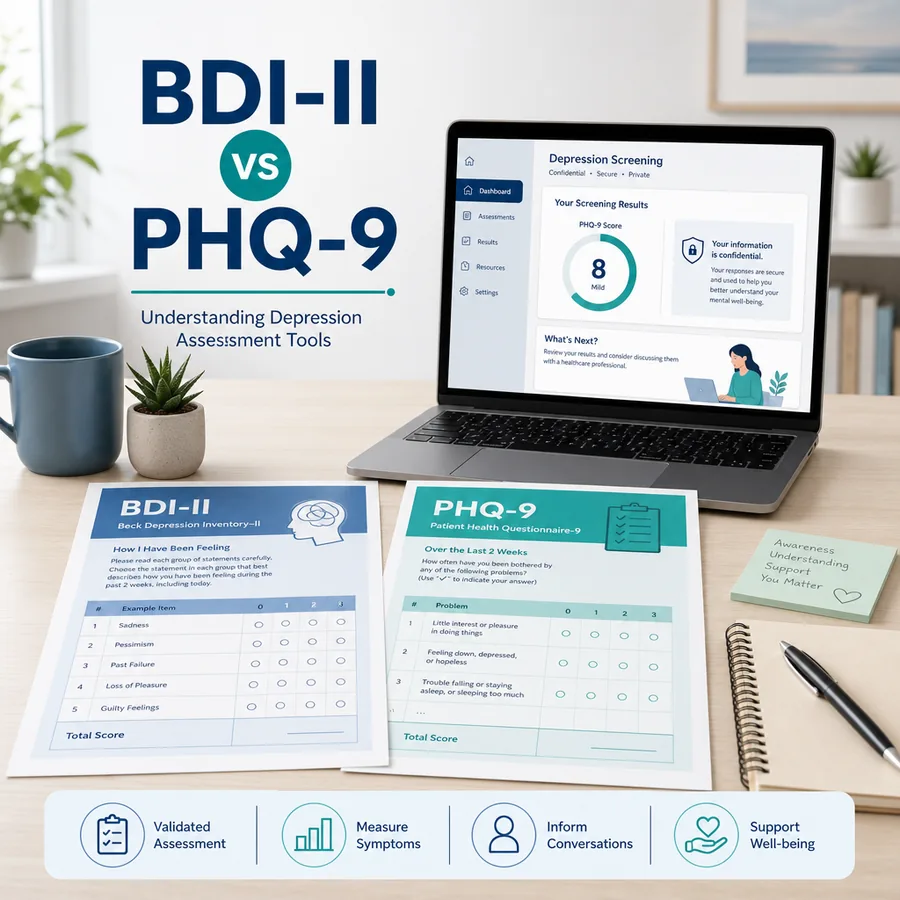
What Is the Beck Depression Inventory?
The Beck Depression Inventory is a self-report questionnaire designed to measure the severity of depressive symptoms. The modern version most people refer to is the Beck Depression Inventory-II. It is commonly discussed in clinical psychology, psychiatry, research, and assessment contexts.
Unlike a casual depression quiz, BDI-II was built to measure symptom severity across areas such as mood, self-evaluation, energy, sleep, appetite, and functioning. It can help clinicians understand the intensity of symptoms, monitor change over time, and add structured data to a broader evaluation.
However, a BDI-II score is not the same as a diagnosis. A clinician also considers duration, impairment, medical conditions, medication effects, substance use, grief, trauma, anxiety, bipolar symptoms, and safety risks. That broader context is why professional interpretation matters.
What a BDI-II score can and cannot tell you
- It can estimate the current severity of self-reported depressive symptoms.
- It can support symptom tracking when used consistently and appropriately.
- It cannot confirm major depressive disorder by itself.
- It cannot replace a mental health assessment by a qualified professional.
- It should not be treated as emergency triage if someone has suicidal thoughts or immediate safety concerns.
Why Free Online BDI Tests Can Be Risky
Search results for Beck depression test online often include unofficial quizzes. Some may be educational summaries. Others may attempt to reproduce copyrighted or licensed assessment material. The user experience can look polished, but the important question is whether the tool is authorized, scored correctly, and transparent about its limits.
Watch for red flags: no author information, no medical disclaimer, no crisis guidance, no explanation of scoring, claims of diagnosis, forced email capture before results, or a promise that one online test can tell you exactly what condition you have.
Another issue is interpretation. Two people can have similar scores for different reasons. One person may be experiencing depression after a major loss. Another may have sleep deprivation, thyroid symptoms, medication side effects, or anxiety that overlaps with depressive symptoms. A score can start a conversation, but it should not end the conversation.
For a free self-check, PHQ-9 has a practical advantage: it is short, widely used in primary care, easy to score, and designed around the previous two weeks of symptoms. That makes it useful when your immediate question is, “Should I pay attention to these symptoms and consider asking for help?”
BDI-II vs PHQ-9: Key Differences
BDI-II and PHQ-9 both relate to depression, but they were not designed for identical use. BDI-II is often used as a broader symptom severity inventory, while PHQ-9 is commonly used as a quick depression screener and monitoring tool in healthcare settings.
| Feature | BDI-II | PHQ-9 |
|---|---|---|
| Main purpose | Measures severity of depressive symptoms | Screens for depression symptoms and tracks severity |
| Typical setting | Clinical assessment, therapy, research, formal evaluation | Primary care, online self-screening, mental health intake, follow-up |
| Free online use | Often restricted or licensed; unofficial copies need caution | Commonly available as a free screening questionnaire |
| Length | Longer than PHQ-9 | 9 symptom questions |
| Best fit | When a professional wants a structured severity inventory | When a person wants a fast, understandable first screen |
| Limitations | Should be interpreted in clinical context and used appropriately | Short screener; does not diagnose depression alone |
Is BDI-II more accurate than PHQ-9?
There is no single answer that applies to every person and every setting. Accuracy depends on the population, language, cutoff score, clinical purpose, and how results are interpreted. BDI-II may provide a more detailed severity profile. PHQ-9 may be better for fast screening, repeated monitoring, and easy communication with a healthcare provider.
If you need a personal first step today, the question is not “Which test is perfect?” The better question is “Which tool gives me useful, understandable information without pretending to diagnose me?” For that use case, PHQ-9 is usually easier and more appropriate.
Which Depression Screening Tool Should You Use?
Use the tool that matches your situation. A person checking symptoms privately at home does not need the same workflow as a psychologist documenting progress during treatment.
Use PHQ-9 if you want a free first screen
If you want a quick online depression screening, start with the free PHQ-9 test. It gives a score range, severity category, and next-step guidance without requiring you to use a restricted professional inventory.
Ask about BDI-II if you are already in care
If you are working with a therapist, psychologist, psychiatrist, or primary care clinician, you can ask whether BDI-II is appropriate for your situation. They can decide whether it adds value and interpret the result with your history.
Use a specialized tool when the context is specific
If you are a teenager, a teen-focused screener may be more appropriate. If you are pregnant or postpartum, a postpartum-specific screening tool can better match that context.
For more detail, you can compare available options in our guide to free depression screening tools or read our free vs paid depression tests comparison.
What to Do After a Depression Screening Score
A screening result is most useful when it leads to a clear next step. Do not treat one score as a permanent label. Treat it as a snapshot of symptoms during a specific period.
If your symptoms are mild
Consider monitoring your symptoms, improving sleep consistency, reducing alcohol or drug use, increasing movement if possible, and talking with someone you trust. Retaking the same screener after two to four weeks can show whether symptoms are improving or getting worse.
If your symptoms are moderate or higher
Consider contacting a healthcare provider, therapist, or community mental health clinic. Bring your score, the date you took the screening, and notes about sleep, appetite, concentration, work or school impact, and any major recent stressors. You can also review our depression test results interpretation page before that conversation.
If you have thoughts of self-harm
Skip online testing and seek immediate help. In the United States, call or text 988. If there is immediate danger, call emergency services or go to the nearest emergency department.
FAQ About Beck Depression Inventory Online Tests
Is the Beck Depression Inventory free to use?
The BDI-II is generally treated as a licensed professional assessment. You may find free versions online, but that does not mean they are authorized or clinically reliable. For free self-screening, PHQ-9 is a more practical option.
Can a BDI test online diagnose depression?
No. A BDI score can describe symptom severity, but diagnosis requires a clinical evaluation. Depression symptoms can overlap with anxiety, trauma, grief, sleep disorders, substance use, medical conditions, and medication effects.
What is the best free alternative to BDI-II?
For most adults, PHQ-9 is the best free first-step alternative because it is short, widely used, and easy to interpret. You can take the PHQ-9 online and then read the score interpretation guide.
Should teenagers use BDI-II or PHQ-9?
Teenagers should use age-appropriate screening and involve a trusted adult or healthcare professional when symptoms are concerning. Our teen depression test is designed for adolescent self-checking and teen-specific next steps.
Is BDI-II better than an online depression quiz?
BDI-II is a formal assessment instrument, while many online quizzes are informal. The issue is not just the name of the tool; it is whether the tool is used appropriately, scored correctly, and interpreted with clinical context.
How often should I repeat a depression screening?
If you are self-monitoring, repeating the same tool every two to four weeks can be reasonable. If you are in treatment, follow your clinician's recommendation. Repeating multiple different quizzes every day can increase anxiety without adding useful information.
Sources and Further Reading
- Pearson Assessments BDI-2 product page: publisher information for Beck Depression Inventory assessment products.
- American Psychological Association PHQ-9 PDF: PHQ-9 questionnaire and scoring reference.
- SAMHSA-HRSA Center for Integrated Health Solutions PHQ resource: PHQ-2 and PHQ-9 screening reference.
- 988 Suicide & Crisis Lifeline: crisis support in the United States.